
Autonomous Driving Hardware
In-vehicle system
1. Vehicles and Hardware: The Bridge Between Research and Real-World Systems
Turing’s autonomous driving development doesn’t end with AI models. Implementing models as real-world systems requires integrated hardware design: vehicle selection and modification, sensor configuration, on-vehicle computers, vehicle control interfaces, and safety architecture. These aren’t afterthoughts—they’re tightly integrated into the overall system design.
The work of “running on real vehicles” is more than validation—it’s foundational to the improvement cycle itself. We collect data, train models, deploy to vehicles, validate on public roads, and feed results back to training. Hardware sits at both the entry and exit of this loop.
2. Data Collection Vehicles: Capturing Daily, Reliable Training Data
Full autonomy requires exceptional data quality. Good models only grow on good data. Turing continuously operates data collection vehicles, accumulating driving data every day. The goal here isn’t “building a moving car”—it’s ensuring sensors and recording systems operate stably and capture data without loss, day after day.
This requires: cameras and sensors functioning continuously; collected data being saved in the correct format without interruption; and anomalies being detectable immediately when they occur. In short, a data collection vehicle is a mobile distributed system—and must be designed with operations and monitoring in mind. If this foundation breaks down, no amount of compute will move training forward.
3. On-Vehicle Hardware Configuration: Simple Inputs, Real-World Driving
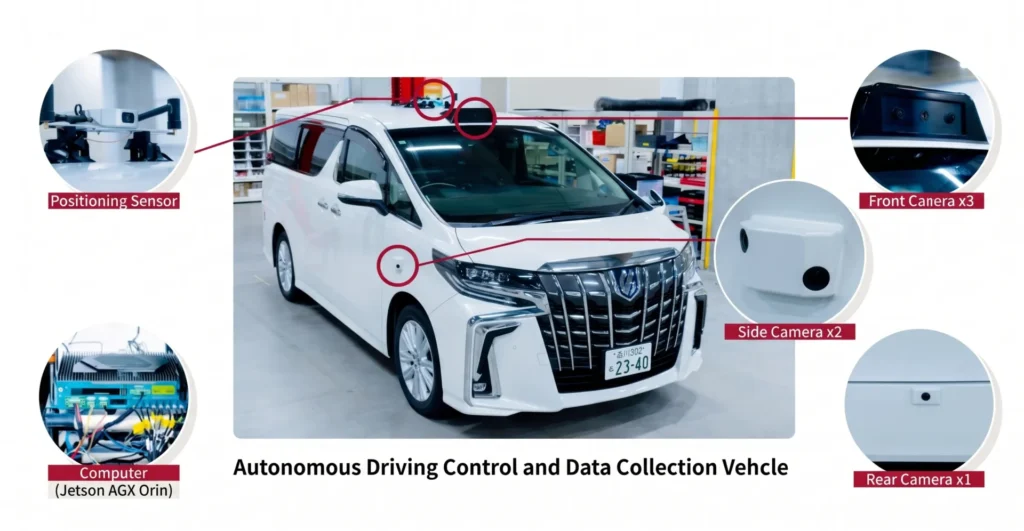
Turing’s on-vehicle hardware configuration is, at first glance, straightforward. The primary input is cameras—multiple cameras mounted around the vehicle perimeter. Positioning sensors (such as GNSS) are also installed to capture the trajectory data required for training and validation.
The on-vehicle computer must operate within the vehicle’s constrained environment: limited power, temperature extremes, and constant vibration. Unlike standard servers or workstations, the configuration requires inherent environmental durability.
Turing runs Linux on the on-vehicle computer, with multiple cooperating processes handling distinct roles: sensor control, inference, logging, and UI. These processes communicate through a Pub/Sub inter-process communication design. Integrating comprehensive system logs and connecting them to raw training data is also a critical function of this architecture.
4. Safety Design: Physical Safeguards Beyond Software
In autonomous driving systems, safety is part of the design—not an afterthought. Turing inserts safety mechanisms at the vehicle interface layer to control behavior in abnormal conditions. A dedicated safety microcontroller is interposed between the vehicle communication interface and the control system, verifying outputs and behavior before passing commands through. Signal processing that requires real-time performance runs on bare metal rather than relying on a general-purpose OS—matching the design to the specific requirements.
Software-level safeguards alone are not sufficient. As a last resort, a physical emergency stop capability is available to physically cut signals—providing a final barrier for human intervention. Autonomous driving systems carry the possibility of “dangerous behavior within the bounds of correct signals,” which is why safety must be layered across multiple levels in operational design as well.
5. Extended Configuration: Experimental Design to Keep the Improvement Cycle Running
On-vehicle computers are commercial products with constraints on configuration flexibility. At the same time, as models grow larger and experimental density increases, situations arise where running inference entirely on the on-vehicle computer becomes difficult.
To address this, Turing provides, in addition to the standard configuration—where inference runs entirely on the on-vehicle computer—an “extended configuration” that offloads inference to an external workstation for larger models and experimental validation. This enables research improvement cycles to continue running without interruption.
This design does not represent the final production architecture. Rather, it is positioned as an experimental configuration for rapidly improving models and systems. In full autonomous driving development, this improvement velocity is itself a competitive advantage.
6. Looking Ahead: Multi-Vehicle Support and Next-Generation On-Vehicle Architecture
The central theme for vehicle and hardware going forward is moving beyond research demonstrations toward practical deployment. To do this, we will first expand support to multiple vehicle types—working toward the ability to deploy autonomous driving capability independent of any specific vehicle model. When a vehicle type changes, sensor placement, control characteristics, signal specifications, and available space all change, so this is not a simple port.
Support for next-generation SoCs and on-vehicle architectures is also critical. Current on-vehicle computers have inherent limitations, and compute and ECU designs capable of running larger models in-vehicle will be required. Looking further ahead, this includes preparing for next-generation platforms, connecting to mass-production-ready embedded architectures, and exploring custom ECU development as needed.
Turing’s autonomous driving hardware is the foundation that connects AI research outcomes to real vehicles and keeps the learning and validation loop running. To make full autonomous driving a viable infrastructure for society, vehicle and hardware capabilities will continue to evolve.
Join us :
Take on the challenge of fully autonomous driving
with a diverse team of talented members
from various backgrounds.