Software Engineer (Optimization & Acceleration)
Role
The autonomous driving system is composed of many modules communicating via Pub/Sub messaging. While dependencies are kept as simple as possible, advancing autonomous driving model development and improving model accuracy requires solving a wide range of software issues.
Example challenges: ML model training pipeline construction · model quantization/optimization · sensor data calibration · vehicle motion control implementation
You’ll focus on your areas of strength while also expanding into adjacent domains—the role is designed for versatility and cross-domain growth.
What You’ll Do
Note: You won’t necessarily handle all of the following. You’ll develop in domains where you can leverage your strengths, while gradually expanding into adjacent areas.
- Data calibration and coordinate transformation between different sensor devices
- Accelerate image and video data processing pipelines
- Create and improve datasets
- Research, reproduce, and implement existing papers and implementations
- Evaluate existing implementations using Turing’s proprietary datasets
- Model quantization and optimization
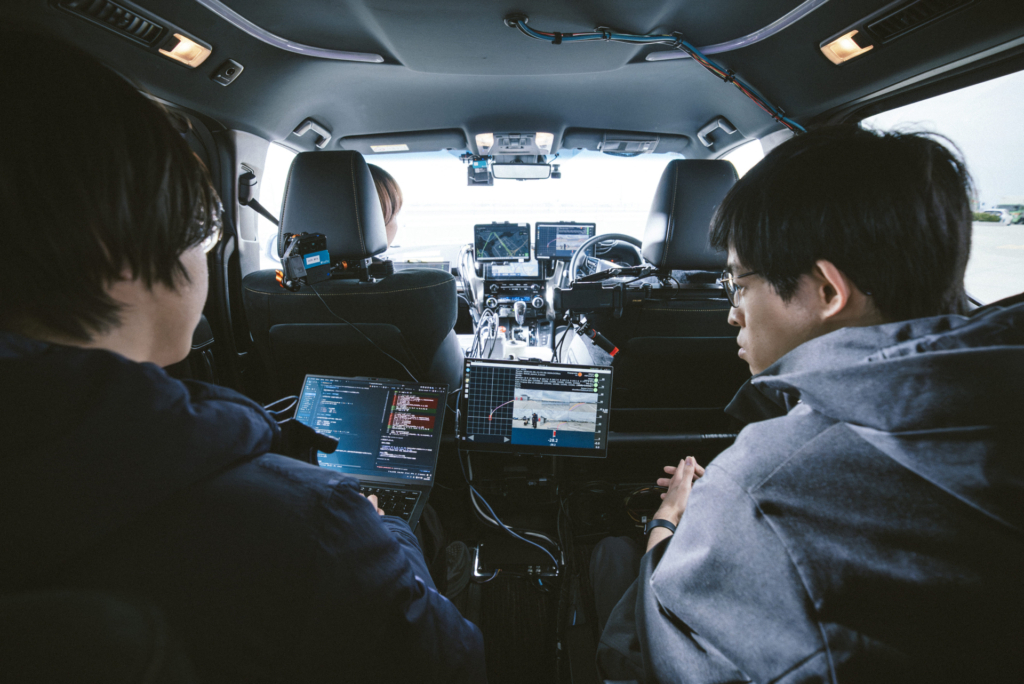
- Conduct model evaluation on real vehicles and manage experiments
- Design and implement vehicle motion control systems and algorithms
- Evaluate and tune control performance using real vehicles
What We’re Looking For
You have strong systems programming skills and deep understanding of machine learning fundamentals. You’re comfortable with low-level optimization and profiling tools. You have experience with model optimization techniques and can reason about performance tradeoffs.
Beyond technical depth, you think creatively about optimization approaches and can communicate complex technical ideas clearly. You collaborate well with ML and systems teams, understanding both research constraints and production requirements.
Tech Stack
- Python and C/C++ for optimization
- CUDA or similar GPU programming
- Deep learning frameworks (PyTorch, TensorFlow)
- Profiling and benchmarking tools
- Model compression techniques
- Quantization and inference libraries
- Performance analysis tools
What Makes This Role Special
Working as a Software Engineer (Optimization & Acceleration) at Turing gives you access to end-to-end autonomous driving model development—one of the most advanced ML development methodologies in existence.
You’ll also see the systems and modules you develop actually deployed on real-world vehicles driving on public roads. Working on critically important components of a product that carries people and contributes to society gives you a direct, tangible sense of the scale of your technical impact.
Your mission is to run improvement cycles by repeatedly testing the team’s models against your systems and in real-vehicle testing. You’ll use real-world feedback—not just desk analysis—to powerfully advance autonomous driving development.
Key Qualifications
- ML/software engineer with development experience in the autonomous driving domain
- Engineer with ML/software/control development experience at an automotive company
- Engineer with ML/software/control development experience at a systems development company
- Motivated by the ambitious goal of fully automating the control layer
- Broad interest in vehicle dynamics and vehicle motion
- Motivated to contribute to building the foundation of full autonomous driving through control module development
Cross-Functional Collaboration
With ML Engineers
You’ll primarily connect control modules with the trajectories (waypoints) output by the autonomous driving neural network model. Based on model trajectory output, you’ll develop appropriate longitudinal and lateral control, tuning the system so the actual vehicle moves comfortably and safely. This is the critical “bridge” that accurately reflects ML model intent in real vehicle behavior.
This role lets you dive deep into machine learning from a control engineering perspective. Working toward the long-term goal of fully automating the control layer, your control system development becomes the foundation that supports full autonomous driving—an enormous source of purpose.
With Software Engineers (Driving Systems)
You’ll coordinate the PUB/SUB communication integration between your developed control module application and other modules. Maintaining the overall software architecture integrity and system coherence is a core responsibility. In a multi-component system, you need to develop with constant awareness of how your module impacts the broader system.
Operating at both the individual module level and the system level simultaneously builds a unique skill: the ability to understand the whole system and optimize your piece within it. The satisfaction of building a high-quality system piece by piece—while always keeping the full picture in view—is a powerful source of technical fulfillment.